TL;DR
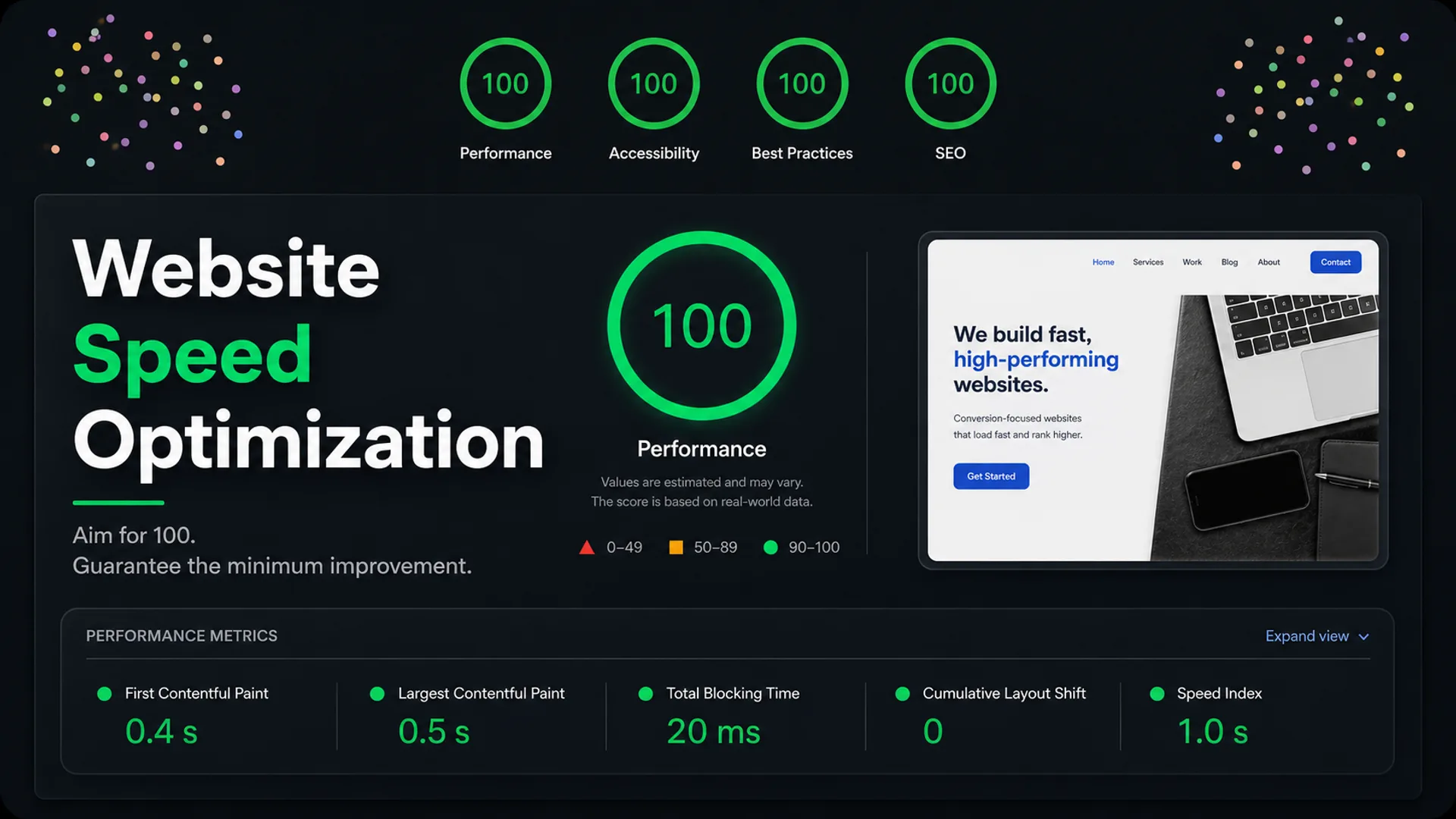
Lakion optimizes websites to get as close as possible to 100/100 in Lighthouse and PageSpeed Insights, but we do not promise a fake 100% guarantee for every website. Instead, we promise a measurable minimum improvement after audit: better Core Web Vitals, a higher Lighthouse score, or a clear technical report showing the exact third-party, hosting, or platform limits blocking further gains.
Google Lighthouse screenshots with four green 100 scores look great. They are also not always the honest promise to make before seeing the website.
Some websites can reach 100 in Performance, Accessibility, Best Practices, and SEO. Some cannot without changing hosting, removing heavy third-party scripts, rebuilding themes, or replacing plugins that load too much JavaScript. That is why Lakion's website speed optimization offer is simple: we aim for 100, but we guarantee a realistic minimum improvement.
If you run a Sri Lankan business website, an e-commerce store, or a lead-generation landing page, speed is not just a technical vanity metric. It affects search visibility, ad landing page experience, conversion rate, and the way customers feel when they open your site on mobile data.
What Website Speed Optimization Means
Website speed optimization is the process of reducing load time, improving Core Web Vitals, and making your pages feel faster on real user devices. It covers image delivery, JavaScript, CSS, fonts, server response, layout stability, caching, and third-party scripts.
At Lakion, we optimize for the metrics Google actually exposes through tools such as PageSpeed Insights, Lighthouse, and the Search Console Core Web Vitals report.
The work usually includes:
- Compressing and resizing oversized images
- Converting heavy image assets to WebP or AVIF where supported
- Fixing render-blocking CSS and JavaScript
- Removing unused scripts, plugins, and tracking tags
- Improving Largest Contentful Paint (LCP)
- Reducing Total Blocking Time (TBT) in Lighthouse
- Preventing Cumulative Layout Shift (CLS)
- Improving mobile performance for users on slower devices
- Setting up better caching, preloading, and font loading
- Auditing hosting, CDN, and server response time
Our Guarantee: Aim for 100, Promise the Minimum
The honest guarantee is not "every website will get 100." The honest guarantee is that we will find the bottlenecks, fix what can be fixed inside the agreed scope, and deliver a measurable minimum improvement on the target pages.
For eligible websites where Lakion has access to the codebase, CMS, hosting, and performance-critical assets, our minimum performance promise is:
| Starting Point | Minimum Outcome We Work Toward | What Counts as Proof |
|---|---|---|
| Lighthouse Performance below 50 | Move into the 50-89 range or document hard blockers | Before/after Lighthouse report |
| Lighthouse Performance 50-89 | Improve by at least 10-15 points or move into green | Before/after PageSpeed Insights test |
| Core Web Vitals failing | Fix the highest-impact LCP, INP/TBT, or CLS issue first | Field data trend plus lab diagnostics |
| Already 90+ | Reduce regressions and improve the weakest metric | Metric-level comparison |
This is deliberately practical. A score of 100 is possible on some pages, especially clean landing pages and modern Next.js builds. But if a website depends on heavy ad scripts, live chat widgets, old WordPress themes, large sliders, or cheap shared hosting, the honest first step is to remove the weight before promising perfection.
Why We Do Not Promise 100% for Every Website
Google itself warns that Lighthouse scores can fluctuate because testing conditions change. Device speed, network conditions, browser extensions, A/B tests, ads, antivirus software, and routing can all affect the final score.
Chrome's Lighthouse documentation explains that the Performance score is a weighted average of several metrics including First Contentful Paint, Speed Index, Largest Contentful Paint, Total Blocking Time, and Cumulative Layout Shift. It also notes that taking a site from 99 to 100 can require a surprisingly large amount of extra improvement.
That is why a blanket "100 guaranteed" promise can become misleading. It ignores real-world constraints such as:
- Third-party scripts from Meta Pixel, Google Ads, chat widgets, maps, booking systems, and CRMs
- Slow hosting or overloaded shared servers
- WordPress themes with bundled page builders and unused CSS
- Large product images uploaded without compression
- Fonts loaded from multiple sources
- Payment gateways and e-commerce plugins
- Tracking scripts required for advertising measurement
- Content that changes layout after load
We prefer a promise your business can trust: we optimize toward 100, guarantee visible improvement, and show the evidence.
The Metrics We Care About Most
The green score matters, but the real goal is a faster user experience. Google's Web Vitals guidance focuses on three Core Web Vitals: LCP for loading, INP for interactivity, and CLS for visual stability.
Here is the simple version:
| Metric | Good Target | What It Means for Your Customer |
|---|---|---|
| LCP | 2.5 seconds or less | The main page content appears quickly |
| INP | 200 milliseconds or less | The page responds quickly when someone taps or clicks |
| CLS | 0.1 or less | The page does not jump around while loading |
For lab testing, Lighthouse uses Total Blocking Time as a proxy for responsiveness because a synthetic test cannot fully measure real user interaction. That means we look at both lab data and field data before making recommendations.
What We Optimize First
The fastest wins usually come from the heaviest assets and the most obvious blocking resources. We start there because it gives the business a visible improvement quickly.
1. Hero Images and Above-the-Fold Media
Most slow pages have one oversized hero image doing too much damage. A 4 MB JPEG uploaded straight from a camera can destroy mobile performance. We resize it, compress it, convert it to a modern format, and load it in the correct priority.
2. JavaScript and Plugin Weight
Too many plugins and scripts make the browser work harder before the page becomes usable. We remove unused scripts, delay non-critical third-party tags, and reduce the JavaScript that blocks interaction.
3. CSS, Fonts, and Render Blocking
Fonts and CSS can delay the first visible content. We audit font loading, preload critical assets where useful, and remove unused CSS where the platform allows it.
4. Layout Shift
Pages that jump while loading feel broken. We reserve image dimensions, avoid late-loading banners pushing content down, and fix unstable embeds so users can tap without frustration.
5. Hosting and Server Response
Sometimes the website itself is not the only problem. If the server is slow, every page starts late. In that case, we recommend better hosting, CDN caching, or a rebuild path if the current stack is holding the business back.
What You Get From a Lakion Speed Optimization Project
You get more than a screenshot. You get a clear before-and-after performance trail.
Our standard delivery includes:
- Before audit with PageSpeed Insights and Lighthouse screenshots
- A prioritized issue list in plain English
- Fixes applied to the agreed target pages
- Image compression and modern format conversion where needed
- Script, CSS, font, cache, and layout-shift improvements
- After report showing what changed
- Notes on anything that blocks a higher score
- Recommendations for the next round if the site needs deeper rebuild work
For businesses already working with Lakion on web design in Sri Lanka, SEO in Sri Lanka, or Google Ads campaigns, performance optimization is usually built into the growth plan because slow pages waste traffic.
When 100 Is Realistic
A 100 Lighthouse score is most realistic when the page is clean, focused, and built on a modern stack. Static pages, fast hosting, optimized images, minimal JavaScript, and careful font loading make a big difference.
It is less realistic when the page must run many third-party scripts, complex e-commerce functionality, tracking pixels, booking widgets, chat tools, and old page-builder code. Those things may be necessary for the business, but they carry performance cost.
The right question is not "can we force a screenshot to show 100 once?" The better question is: can real customers load, read, tap, and convert faster than before?
That is the result we optimize for.
Who This Is Best For
Website speed optimization is a strong fit if:
- Your PageSpeed score is red or orange on mobile
- Your Google Ads landing pages are slow
- Your SEO pages get impressions but poor engagement
- Your WordPress website has too many plugins
- Your e-commerce store has large product images
- Your website looks good but feels slow on mobile
- Search Console shows Core Web Vitals issues
- You are planning a redesign and want performance built in from day one
If your website is already fast, we can still help protect it from regressions. Performance is not a one-time trophy. It needs maintenance when content, plugins, tracking, and campaigns change.
FAQ
Can you guarantee a 100 PageSpeed score?
We can aim for 100, and some pages can reach it, but we do not guarantee 100 for every website before an audit. The honest guarantee is a measurable minimum improvement on pages we can control, with before-and-after reports and a clear blocker list if outside systems limit the score.
What minimum improvement can I expect?
For eligible pages, we usually commit to moving a poor score into the next score band or improving an orange score by at least 10-15 points. If the site is already 90+, the goal becomes stabilizing the score and improving the weakest metric instead of chasing vanity points.
Will speed optimization help SEO?
Speed alone will not replace good content, backlinks, and technical SEO. But Core Web Vitals are part of page experience, and faster pages generally improve usability, engagement, and conversion. For SEO projects, speed optimization is one piece of the larger ranking system.
Do you optimize WordPress websites?
Yes. We optimize WordPress websites by reducing plugin weight, improving image delivery, fixing caching, cleaning theme assets where possible, and reducing render-blocking files. If the theme or hosting is the real limitation, we will say that clearly instead of hiding it.
How long does website speed optimization take?
Most small business websites take 3-7 working days for an initial optimization pass. Larger WordPress sites, WooCommerce stores, or custom platforms can take longer because each template, plugin, and integration needs to be tested carefully.
What happens if my hosting is the main problem?
If hosting is the bottleneck, we will show the server response issue in the audit and recommend the most practical fix. That might mean CDN caching, better hosting, or a rebuild path for businesses that need serious SEO and paid ads performance.
Get a Faster Website Without Fake Promises
If your website is slow, Lakion can audit it, optimize it, and show you the before-and-after results. We will aim for the green zone. We will push toward 100 where the platform allows it. But the promise we stand behind is better: a clear minimum improvement and honest evidence.
Start with a speed audit through our contact page, or explore our performance-focused web design service if your current site needs a stronger foundation.